Handing someone a key to your home is a bigger decision than choosing who mows the lawn. They will be alone in your bedrooms, around your kids’ things, your pets and the heirloom on the mantel. So it makes sense that one of the most common questions we hear from Covington families is not “how much?” but “how do I know I can trust you?”
Most people answer that by searching for an insured cleaning company. That is a smart instinct, but “insured” is only one piece of the picture. This guide explains what insured, bonded and background-checked actually mean, compares hiring a cleaning company with hiring an independent cleaner, and gives you six questions to ask anyone before you hand over a key — including us. We will also be honest about when an independent cleaner is the better choice.
What “insured cleaning company” really means
When a company says it is insured, it usually means it carries general liability insurance. If a technician knocks a lamp off a table, scratches a hardwood floor or floods a bathroom, that policy is what pays for the damage, rather than you or your homeowner’s policy.
Two other protections often get lumped in with “insured,” and they are not the same thing:
Bonded
A bond (often called a janitorial or fidelity bond) is protection against theft by an employee. Liability insurance covers accidents; a bond covers dishonesty. A company can be insured without being bonded, so ask about both.
Workers’ compensation
If a cleaner slips on a wet floor in your home and gets hurt, who pays the medical bills? With a company that carries workers’ comp for its employees, the answer is the company’s policy. With an uninsured individual, the question can land uncomfortably close to your homeowner’s policy.
Background-checked
Insurance pays after something goes wrong. A background check helps prevent it from going wrong in the first place. Ask what the check covers and whether every person who enters your home has passed one — not just the owner.
Insured cleaning company vs. independent cleaner in Covington
Both options can work well. They simply carry different trade-offs. Here is the honest side-by-side.
Working with a cleaning company
- Insurance and bonding are typically carried by the business, and you can ask for a certificate.
- Employees, not your employees. The company handles payroll and taxes, so you are not stepping into an employer role.
- Backup coverage. If your regular technician is sick or on vacation, someone trained on your home’s checklist can still come.
- Accountability. There is an office to call, a manager to escalate to, and usually a written satisfaction guarantee.
- Trade-off: the per-visit price is often higher, and you may occasionally see a different face on your team.
Working with an independent cleaner
- Personal relationship. The same person every time, and often more flexibility on small special requests.
- Often a lower per-visit rate, because there is less overhead.
- Insurance varies widely. Some independents carry their own liability coverage and bonding; many do not. You have to ask.
- No backup. When they are sick, travelling or move away, your cleaning simply stops.
- Possible tax responsibilities. If the IRS would consider your cleaner your household employee — generally, if you control how and when the work is done — and you pay $3,000 or more in cash wages in 2026, you may owe Social Security and Medicare taxes. The rules are explained in IRS Publication 926. A cleaner who runs a genuine independent business is usually treated differently, but it is worth understanding before you start.
When an independent cleaner is the right call
We would rather you make a good decision than a decision in our favor. An independent cleaner can be the better fit if:
- You have a small home or apartment and need a few hours of light upkeep, not a full-home system.
- You already know and trust the person — a long-standing referral from a neighbor or family member.
- They can show you a current liability insurance certificate, and you are comfortable without backup coverage.
- Budget is the deciding factor and you are willing to manage scheduling yourself.
A company tends to be the better fit when you want consistent recurring service, coverage when someone is out, a formal guarantee, and no employer paperwork — or when you will not be home during cleanings and want clear accountability for who has access.
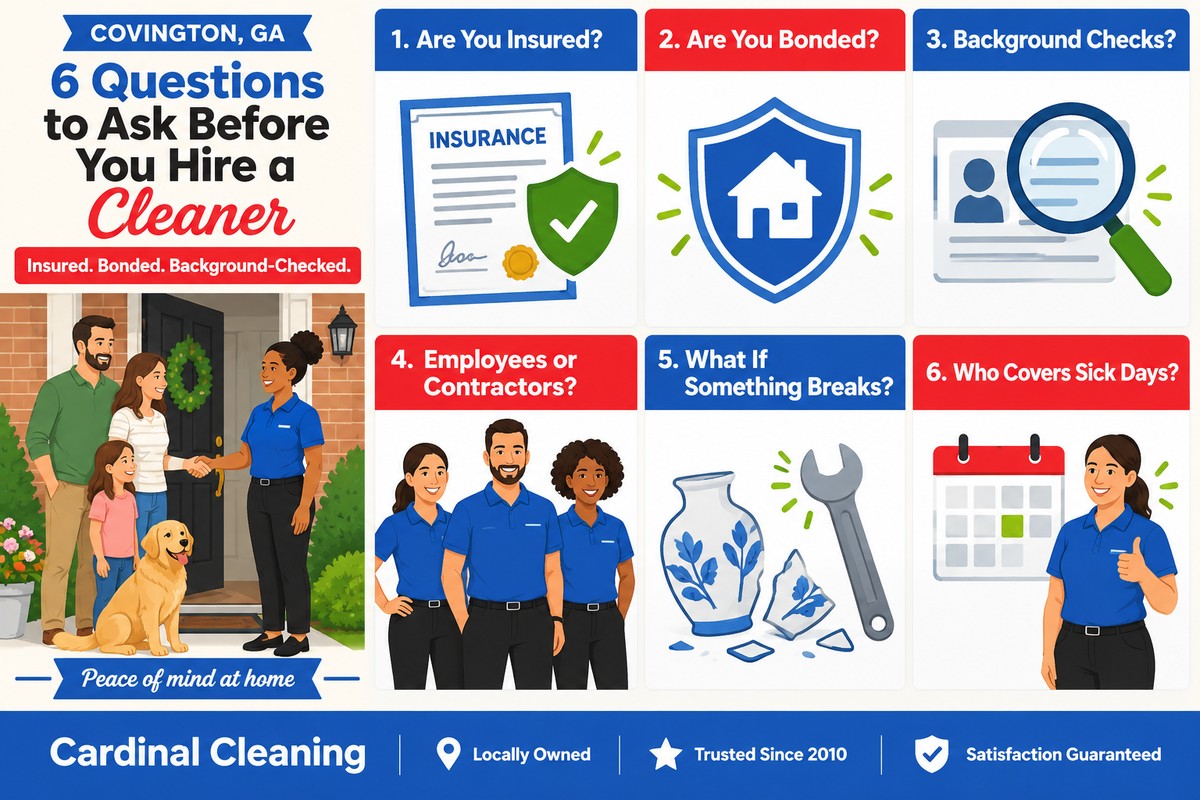
6 questions to ask any cleaner before you hand over a key
Ask these on the first call. A trustworthy cleaner, company or independent, will answer every one without hesitating.
1. “Are you insured, and can I see the certificate?”
A certificate of insurance shows the insurer, the coverage type and the policy dates. “We’re covered” without a document is not the same thing.
2. “Are you bonded?”
Remember: insurance covers accidents, a bond covers theft. You want both.
3. “Is everyone who enters my home background-checked?”
Ask specifically about new hires and substitutes, not just the regular team.
4. “Are your cleaners employees or contractors?”
This tells you who is responsible for payroll taxes, training and workers’ compensation — and how much control the business has over quality.
5. “What happens if something gets broken or missed?”
Listen for a clear process: who you call, how fast they respond, and whether they come back to fix a missed area. A written satisfaction guarantee is a good sign.
6. “Who comes if my regular cleaner is sick?”
For recurring service this matters more than people expect. Ask whether a substitute follows the same checklist and notes for your home.
How to check an insurance certificate in five minutes
Most people take a certificate at face value. A few quick checks tell you whether it actually protects you:
- Match the name. The “named insured” on the certificate should match the business name on your estimate or invoice.
- Check the dates. Policies renew yearly. A certificate that expired last spring protects no one today.
- Look at the coverage type. You want general liability for residential cleaning work. If the company says it is bonded, ask for that documentation separately — a bond usually does not appear on a standard liability certificate.
- Call the insurer. The agent or carrier is listed on the form. A short call confirms the policy is active.
- Ask about limits. If you have high-value flooring, antiques or artwork, ask what the coverage limit is per incident.
It also helps to know exactly what a clean should include before the first visit, so “missed” is easy to define. Our house cleaning checklist shows the room-by-room standard we work to; use it as a yardstick for any cleaner you interview.
Red flags worth walking away from
- Cash only, with no written estimate, invoice or receipt.
- Vague answers about insurance (“it’s handled”) or refusing to show a certificate.
- A firm quote over the phone before they know anything about your home’s size or condition.
- No reviews, no references and no physical business address.
- Pressure to sign a long contract on the spot.
What trust looks like in a Covington home
Covington homes run the full range — historic houses within walking distance of the Square with original wood floors and plaster walls, established neighborhoods off Highway 278, and newer subdivisions filling in across Newton County as the area grows. Each one raises its own trust questions.
- Historic and older homes have finishes that do not forgive the wrong product: old heart pine, plaster and antique fixtures. Ask whether technicians are trained on delicate surfaces, and what insurance covers if something irreplaceable is damaged.
- Busy commuter households often are not home during cleanings. That makes key handling, garage codes, alarm instructions and locking up afterward part of the trust conversation.
- Homes with pets need a cleaner who will follow instructions about gates and doors every single visit — a small thing that matters enormously.
- Georgia humidity means wet-mopped floors and bathrooms take longer to dry than people expect; a careful cleaner leaves floors safe to walk on and fans running where you allow it, not a slip hazard for kids and older family members.
How Cardinal Cleaning answers those six questions
Since you should ask every company these questions, here are our answers, plainly:
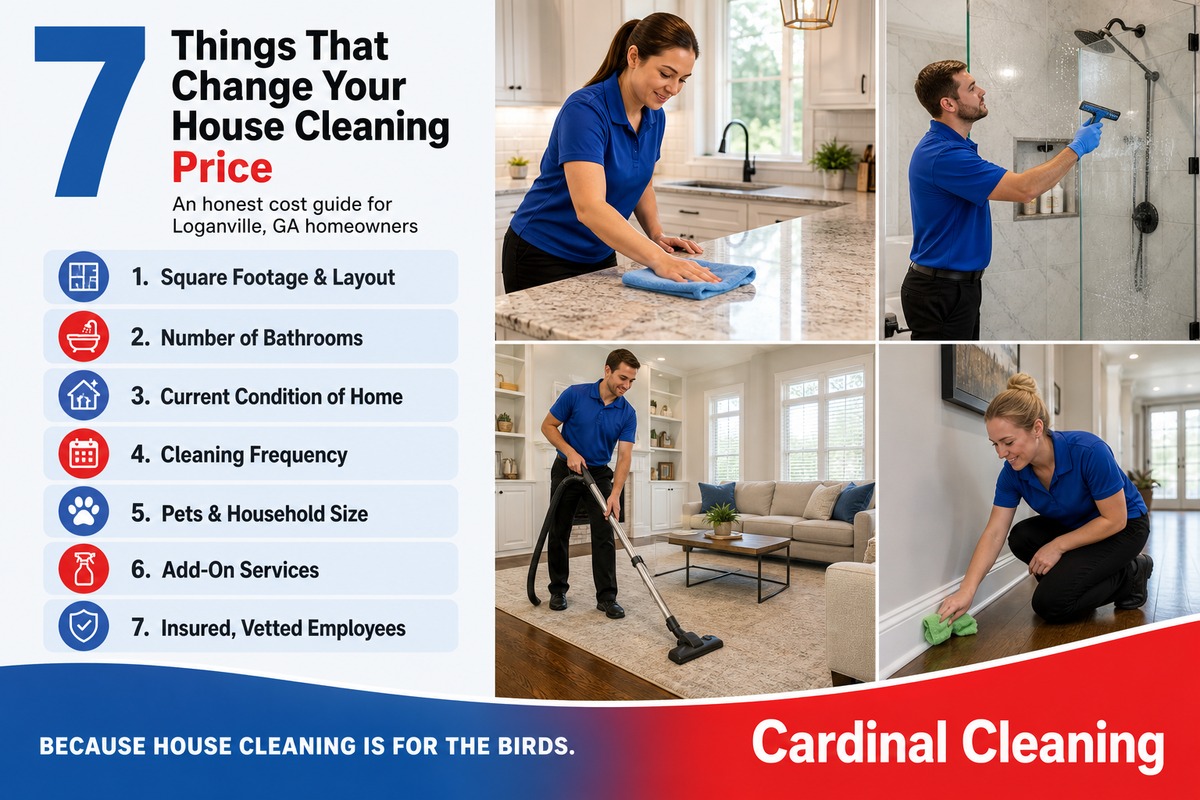
- Insured and bonded: yes. Every Cardinal Cleaning technician is thoroughly vetted, background-checked, insured and bonded.
- Employees: our technicians are our team members, and Cardinal Cleaning pays the employee payroll taxes — so you are never responsible for them.
- Training: every technician completes our in-house training program before entering your home, and works from a detailed checklist room by room.
- If something is missed: our work is backed by a 100% satisfaction guarantee — contact our office and we will make it right.
- Consistency: we try hard to send the same friendly face to your home each visit, especially on weekly or biweekly schedules.
- Access: you do not need to be home. Many clients use a lockbox, garage code or smart lock, and we follow your instructions for securing doors, gates and alarms when we leave.
We are a locally owned company that has served the Greater East Atlanta area since 2010. You can read more about how we work on our house cleaning services page and in our frequently asked questions.
If you live in Covington, Porterdale, Oxford or anywhere in Newton County, visit our Covington house cleaning and maid services page, or request a free quote. Ask us all six questions — we would genuinely like you to.